
Surviving Suicide Loss: One Family’s Journey Through Grief and Their Son’s Art
The Jed Foundation (JED)
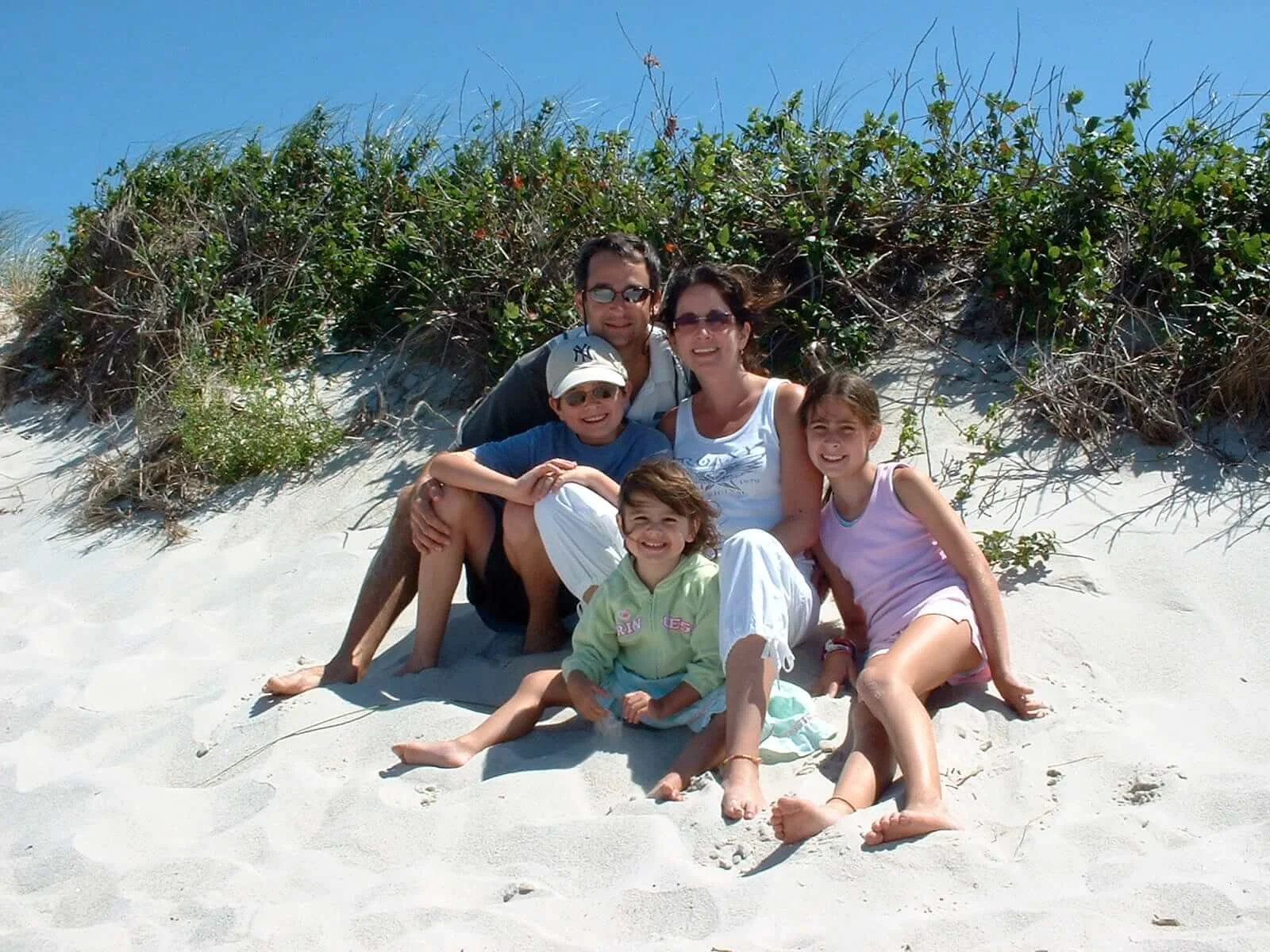
The Bernstein family at Cape Cod, Massachusetts. Jason (age 12, back left) with his sister Jessica (age 10), sister Cayla (age 3), and parents Lauren and Brian.
A couple of times a year, the Bernstein family gets together to watch Jason’s old films.
“He made over 100 home movies when he was younger. We love watching those,” his father, Brian, says. “Those were mostly happy times before he really started to spiral.”
In the very early ones, he’s at home directing his sisters and their friends. In others, he’s sitting at a piano, lost in improvisation.
His later work during and just after his time at Chapman University is more polished, sometimes funny, sometimes dark. “His final piece on the piano hurts,” Brian says. “I just feel his pain when I listen to it, and the abrupt ending is haunting.”
Jason died by suicide when he was 25 years old.
It’s been six years, and his family mostly talks about how funny and charming he could be. That’s the version they hold closest — the kid whose imagination filled every room.
He was creative from the beginning. At 2, he was already fascinated by music, pretending to strum along with a bike pump or anything else he could find.
But, despite his outward charm and humor, Jason experienced complex emotions that, at times, seemed to make the world harder to face.

Jason Bernstein at age 20.
His parents saw signs early. Anger that lingered long after even a minor slight, overwhelming anxiety about school, a shyness that kept him close to his mother’s side.
By his teens, the anxiety had sharpened into shame. He grew afraid of blushing, of being seen. “He wanted so badly to do something about the blushing,” his mother, Lauren, recalls. “He even asked about surgery.”
He tried a combination of therapy, medication, hospitalization, and even a wilderness program, but his complex mental health condition persisted. “We tried everything we could possibly imagine trying. And it didn’t stop it,” Brian says.
“The unlucky ones are the families who never see it coming. We did. And it’s not anybody’s fault when these things happen.”
Their advice to other parents is to keep showing love, even when it’s hard. Don’t take the pain personally.
“The thing that got us through it was holding onto each other,” Lauren says. “We didn’t let it destroy everything else.”
After Jason died, they found a short journal he’d kept near the end. On one page, he’d written two words: Good parents.
“He knew we loved him,” Brian says. “That means everything.”
In the years since, they’ve searched for ways to keep Jason’s creativity alive. Brian and Lauren — drawing on Brian’s more than two decades in the toy industry — started Jasey’s Toy Chest, a toy company launching in early 2026. Their toys help toddlers and preschoolers develop early childhood skills like emotional regulation, frustration tolerance, social connection, and resilience, building a foundation for emotional wellbeing from the earliest years. They’re a supporter of The Jed Foundation’s work in youth mental health.
“We wanted to do something that would keep Jason’s memory alive for us,” Brian says. “Something that reflected who he was — curious, creative, full of imagination — and that could help kids like him.”
When the family gathers to watch Jason’s films, they are transported back to earlier times as the house fills again with his voice and music.
In these moments, they feel connected to Jason once again.
